

Fall starts this week, and it changes one thing about getting dressed that nobody accounts for: from now until spring, a jacket comes with you.
Most going-out advice pretends that isn't true. It styles the outfit as if it'll be seen whole, in good light, with nothing over it. Then you actually leave the house, and for large stretches of the night the outfit is a neckline, a hemline, and whatever the jacket doesn't cover. Sometimes that's ten minutes. Sometimes it's the entire night, because the bar has no coat check and you are not putting your jacket on a barstool.
So the useful question in September isn't what looks good. It's what your jacket is going to do that night. Four answers below, and the piece that handles each.
Find your night
| What the jacket does | What the outfit has to do | What you wear |
|---|---|---|
| Stays on all night | Read complete above and below it | Katrina Cowl Neck Maxi Dress, Tan |
| On, off, on, off | Survive sleeves without resetting | Roxanne Knit Dress, Green |
| Comes off at the door | Earn the reveal | Sophia Jumpsuit, Black |
| Becomes part of the look | Work in halves | Vivienne Two Piece Set, Copper |
1. The jacket never comes off

There is no coat check. There is no chair you trust. The place is standing room only and it's fifty-four degrees, and the jacket is staying on your body from the moment you leave until the moment you get home.
This is the night that wrecks a mini. A short hem under a jacket that hits at the hip reads as a jacket and legs, and the dress disappears entirely. You spent the money on a dress nobody will see.
A floor-length skirt solves it structurally. The Katrina Cowl Neck Maxi Dress in Tan gives you an unbroken line from the jacket hem to the floor, so the outfit still reads as an outfit with a coat over it, not as a coat with something underneath. The thigh-high slit is what keeps that length from going shapeless, and it does its work at exactly the height a jacket doesn't reach.
The neckline is the other half of the argument. A plunging cowl sits high enough on the chest to be visible above a zipped or buttoned jacket, so the two things anyone sees all night, your neckline and your hem, are both doing something. The tan is deliberate too: against a black or brown jacket, a warm mid-tone separates instead of merging into one dark column.
Why it works: when the jacket is permanent, style the two zones it leaves exposed. Everything in between is not your problem that night.
2. On, off, on, off, on

Three places in one night, two of them a short walk apart. The jacket goes on at the door, comes off at the table, goes back on at the corner, comes off again inside. Six cycles before midnight.
Almost nobody plans for what sleeves do to an outfit. A jacket sleeve dragging across bare skin catches, and anything sitting loose on the shoulder gets pulled with it. Strapless slides down. One-shoulder twists. A tucked top comes untucked on the fourth cycle, and you spend the rest of the night making small corrections in the reflection of a window.
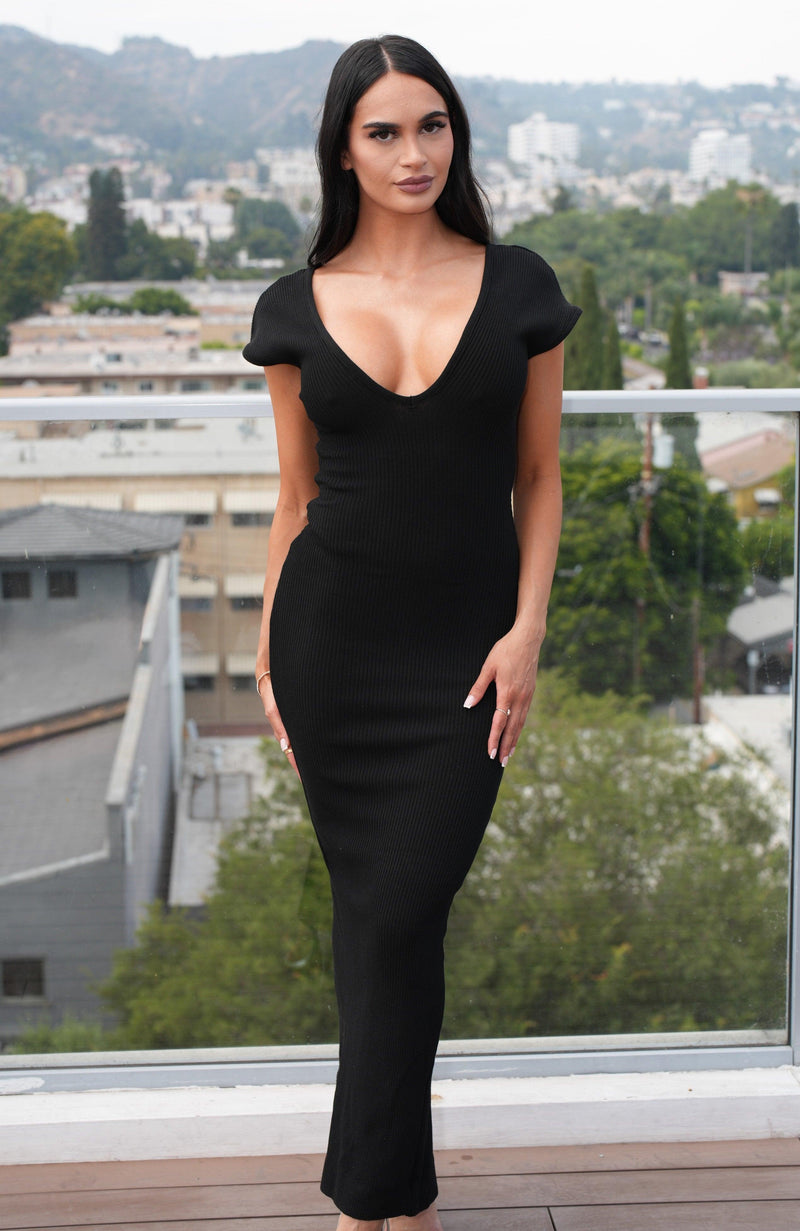
The Roxanne Knit Dress in Green is built past that problem. The cap sleeve gives the jacket a fabric surface to slide over instead of skin to grip, and the high neckline has nothing that can be displaced by a collar. The textured knit is the real advantage, though: it has enough body that a jacket coming off doesn't leave it creased and flattened the way a thin stretch fabric does.
Knit also buys you the option of not wearing the jacket at all on the short walks. A midi in a real knit is warm enough for two blocks in September, which is the difference between six cycles and two.
Fit note: the knit is stretchy and the fit is bodycon. If you're between sizes on this one, size up, since a knit that's pulled tight loses the surface texture that makes it read as fall rather than summer.
3. The jacket comes off at the door and stays off

One venue, all night. A real coat check, or a booth with room for a jacket. You arrive covered, you hand the jacket over, and for the next four hours the outfit is on its own.
This is the only night of the four where the whole thing gets seen, and the moment it happens matters more than people realize. Everyone at the table watches the jacket come off. That is the single biggest reveal you get all season, and it's worth building an outfit around.
The Sophia Jumpsuit in Black is made for that beat. The halter neck with the plunging gold-ring front is the part visible from across the table, and the open back is the part that lands when you turn to sit down. A jacket hides both completely, which is exactly the point: nothing about the outfit is spent while you're wearing it.
The wide leg is the practical half. It's the one silhouette that reads as deliberate for a full seated dinner, doesn't ride up, and covers your legs on the walk in so the jacket only has to handle your arms. A jumpsuit is also one piece, so there's no waistband to check after four hours at a table.
Fit note: the halter is open-backed and no undergarment is included, so sort that layer before you leave. Check the neckline seated and leaning forward, not just standing in front of a mirror.
4. The jacket is part of the outfit

Some nights you want the leather jacket in the outfit, not apologizing for being there. It's in the photos. It's the reason the look works. You are not taking it off and you were never planning to.
A dress can't do this. Put a jacket over a dress and you've covered the top third of a single garment, so what's left is a hem that used to belong to something. A two-piece is the only category that survives being half covered, because the bottom half is a complete piece of clothing on its own.
That's the case for the Vivienne Two Piece Set in Copper. The high-waisted pants with the side cutouts carry the entire look with a jacket over the top, because the waist is already defined by the pants rather than by anything the jacket is hiding. Then when you do take it off, the one-shoulder top is a second outfit, and the copper is a tone that sits with brown, black, and cognac leather instead of fighting any of them.
The cutouts matter here specifically. They sit below where a cropped jacket ends, so the detail that makes the set interesting is visible the whole time the jacket is on. That's the test for any two-piece you plan to wear under outerwear: is anything happening below the jacket hem?
Why it works: a jacket over a two-piece covers one garment. A jacket over a dress covers most of one. Only the first still reads as a finished outfit.
The check to run before you leave
Put the jacket on over the finished outfit and look in a full-length mirror. Not the outfit alone. The outfit with the jacket, which is what most of the night actually looks like.
Three things to ask. Does anything read below the jacket hem, or is it just legs? Is there something happening at the neckline, or does the jacket close over a blank? And when you take the jacket off and put it back on, does anything need fixing afterward?
If all three pass, you've got an outfit that works in both states, and you can stop thinking about it. That's the entire goal. From here to March the jacket is a permanent member of every look you own, and the pieces worth buying this fall are the ones that already knew that.